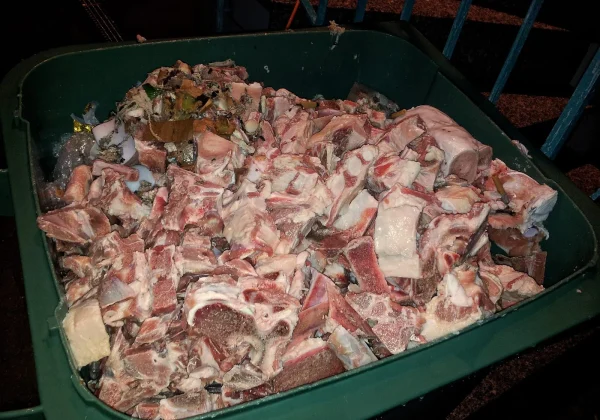

School kitchens come back to life in the first week of September after six weeks of near silence, and the waste arrangements that were switched off in July have to be switched back on before the first service rather than after it. Martlands provides licensed fallen stock and ABP collection and commercial waste services across the North West from a base at Burscough, and school catering food waste collection is a service where predictability matters more than flexibility. A school kitchen produces waste to a timetable that is known a year in advance, and the collection arrangement should reflect that.
What a School Kitchen Actually Produces
The volume is more substantial than people outside catering assume. A secondary school serving several hundred covers across a compressed lunch period generates preparation waste, plate waste and servery returns in a concentrated ninety-minute window, and it does so five days a week during term. Primary schools produce less in absolute terms but proportionally more plate waste, because portioning for young children is inherently imprecise.
Almost all of it is catering waste, which is regulated as a category of animal by-product wherever it contains or has been in contact with material of animal origin. That covers the great majority of what leaves a school servery, and it means the disposal route is not a matter of preference. Our guide to disposing of catering waste sets out the framework in plain terms.
The Separation Duty Now Applies
Business food waste separation requirements have changed the position for schools as they have for every other workplace kitchen, and the direction of travel is towards more separation rather than less. Food waste has to be presented separately from dry recycling and residual waste, which in a school means bins in the right places, staff who know which is which, and a collection that actually removes the separated stream rather than reuniting it in the back of a vehicle.
We have covered the requirements in detail in our explanation of the new business food waste separation law. For a school the practical work is mostly training and bin placement, and September is by far the easiest month to do it, because the routines being established are new anyway.
Storage Between Collections
School sites present a particular storage problem. Bin stores are frequently close to playgrounds or to boundaries with residential neighbours, they are often accessible to pupils, and the site is unattended for long periods including weekends and half terms. Food waste held in open or poorly sealed containers in a warm September attracts flies, gulls and vermin, generates odour complaints, and creates exactly the kind of issue that reaches a governing body.
Leak-proof containers with properly fitting lids are the baseline, and we supply them as part of the service. Site the store on hard standing, away from drainage running to a watercourse, secured against access, and reachable by a collection vehicle without crossing a play area. Collections timed for early morning before pupils arrive avoid most of the practical difficulties at once.
Term Dates, Holidays and Getting the Schedule Right
The distinguishing feature of school catering is that it stops entirely for substantial periods and then restarts at full volume overnight. A collection schedule that runs unchanged through the summer is money wasted, and one that has to be manually reinstated every September will eventually be forgotten by somebody. The sensible arrangement is a schedule built around the school’s published term dates, with collections suspended for holidays and resumed automatically.
Half terms, INSET days and the awkward part-weeks either side of Christmas and Easter all need to be in that plan. Send us the term dates once a year and we will build them into the schedule rather than asking you to remember. Our food waste collection is set up to work this way for education sites.
Breakfast Clubs, After-School Provision and Holiday Schemes
Very few schools now run a straightforward single lunch service. Breakfast clubs extend the catering day at one end, after-school provision extends it at the other, and holiday activity schemes mean some sites are producing catering waste during periods when the main schedule is suspended. These need building into the arrangement explicitly, because a site producing food waste with no collection booked will store it, and storing catering waste through a warm week in August is precisely what causes problems.
Where a school also operates a community facility, a nursery on site or lettings to outside caterers, the waste from those activities forms part of the same stream and the same duty. Our food waste and ABP collection covers the full range on a single arrangement rather than requiring separate contracts.
Documentation the Site Will Be Asked For
Every collection produces the documentation the site needs to demonstrate compliant disposal, including Waste Transfer Notes and Commercial Documents where applicable. Schools are asked for this by local authority officers, by environmental health, and increasingly as part of sustainability reporting for a trust or a local authority. We hold Waste Carrier Licence CB/QE5406MT and Site Licence EAWML/100236, and we are a DEFRA approved processing facility rather than an intermediary.
Serving Schools Across the Region
We collect from education sites across West Lancashire, Merseyside and the surrounding towns, on routes we already run daily. Sites in the Preston food waste collection area range from large secondary schools with full production kitchens to small primaries with a regeneration kitchen and quite different volumes.
The same variety appears across Chorley food waste collection and the surrounding villages, where a number of smaller schools sit close enough together that a single round covers several efficiently. That is usually reflected in what an arrangement costs.
Getting It Set Up Before Term
The best time to sort this is late August. Call 01704 776977 with your term dates and an idea of your covers, and we will put a schedule together, or get in touch through contact us and we will visit the site.