
Takeaways occupy an awkward position in the commercial waste world. They are usually small businesses on high streets, frequently operating from premises with almost no external space, and they generate a waste stream that is disproportionate to their floor area. Martlands provides licensed fallen stock and ABP collection and commercial waste services from a base at Burscough, and takeaway food waste collection is a service built around the reality of a business with a two-metre yard and a bin store shared with the flat upstairs.
The Duty of Care Applies Regardless of Size
The most common misunderstanding in the takeaway trade is that a small business producing modest quantities can use household waste arrangements. It cannot. Waste produced in the course of a business is commercial waste, it carries a duty of care, and it must be transferred to an authorised person with documentation to evidence it. Putting trade waste into a domestic bin, whether the shop’s own or a neighbour’s, is an offence and it is one local authorities pursue actively because it is easy to detect.
Food waste from a takeaway is also catering waste, and where it contains or has been in contact with material of animal origin it is regulated as animal by-product material. That covers essentially all of it in a shop selling meat or fish, which means the disposal route is prescribed rather than chosen. Our food waste and ABP collection handles it under Waste Carrier Licence CB/QE5406MT, Site Licence EAWML/100236 and Animal By-Products Licence No APB/CCN21/373/8002.
What a Takeaway Actually Generates
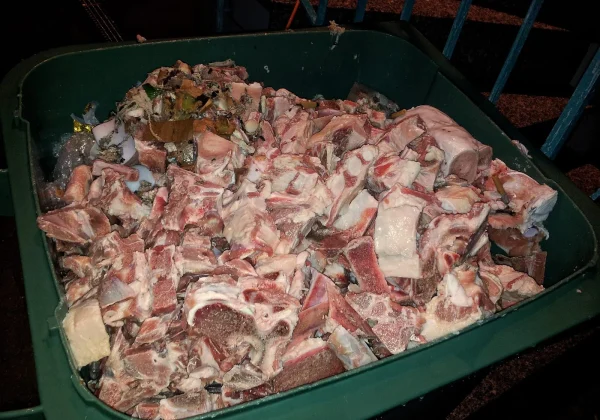
Preparation waste dominates in shops doing their own butchery or fish preparation, and it is heavier and wetter than most operators expect. Fryer-side waste, scraps and batter debris accumulate through a service. Plate waste is minimal because there are no plates, but returned and unsold hot food at the end of the night is a real volume in shops holding stock on a hot counter.
Used cooking oil is a separate stream with its own arrangements and should never go into a food waste container or, worse, down a drain. Fat, oil and grease in a drainage system is the single most expensive mistake a takeaway can make, and it is one that the water authority will trace back to the premises.
Storage in Premises With No Space
This is the practical heart of the problem. A typical high street takeaway has a back yard measured in single figures of square metres, shared drainage, and neighbours immediately above and either side. Containers have to be leak-proof and properly lidded, which we supply as part of our food waste collection service, and they have to be sited where they can be reached by a collection vehicle without being left on the pavement.
Frequency does most of the work here. Where storage space is genuinely minimal, more frequent collections of smaller containers beat weekly collections of large ones, and the cost difference is smaller than most operators assume. Odour and vermin complaints from residential neighbours are the main risk to a takeaway’s licence and its reputation, and they are almost entirely a function of how long waste sits in the yard.
Delivery Kitchens and the New Operating Model
Dark kitchens and delivery-only operations have changed the shape of the trade, and they present a slightly different problem. They operate from industrial units or shared kitchen facilities, often run several brands from one production line, and frequently trade later into the night than a traditional shop. Waste arrangements in shared facilities are a recurring weak point, because responsibility is diffuse and each operator assumes somebody else has it covered.
Each business in a shared kitchen carries its own duty of care and needs its own documentation, or a clearly evidenced arrangement through the site operator. A shared bin with no paperwork protects nobody.
Fly-Tipping and Where Uncollected Waste Ends Up
Trade waste dumped on a back lane is a visible problem in most North West towns, and food and by-product material features heavily in it. Where waste is traced back to a business, the consequences fall on that business regardless of who physically moved it, which is why using an unlicensed operator offering a cash collection is such a poor bargain. Ask for the carrier licence number and keep the paperwork. Our guidance on ABP fly tipping guidance sets out the position and the consequences.
Documentation and the Environmental Health Visit
An environmental health officer inspecting a takeaway will ask to see waste transfer documentation, and being unable to produce it turns a routine visit into something more serious. Every collection generates a Waste Transfer Note, and Commercial Documents where the material is handled as animal by-product, and they need to be kept on the premises rather than at home or with an accountant.
The broader operational requirements for food businesses of this kind are covered in our guidance on food waste and ABP collection for restaurants and catering businesses, and most of it applies directly to a takeaway.
Serving the Trade Across West Lancashire and Wigan
Takeaways are on every high street in the region and we collect from a great many of them on routes we already run. Businesses in the Wigan food waste collection area include a dense concentration of chip shops, kebab houses and delivery operations across the town centre and the outlying districts.
The same is true across Skelmersdale food waste collection and the surrounding townships, where a number of operators sit within a few minutes of one another and can be collected efficiently on one round. That efficiency is generally reflected in the price.
Getting Set Up
Setting up a compliant arrangement is quicker and cheaper than most operators expect. Call 01704 776977 with an idea of your opening hours and the space you have, and we will size the containers and the frequency, or get in touch through contact us. We cover the whole trade from a single-unit chip shop upwards.