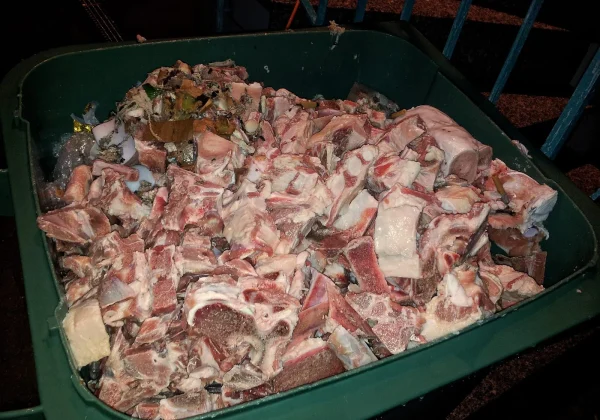
Warrington food waste collection has become a compliance question rather than a nice extra. Since 31 March 2025, businesses in England with ten or more full-time equivalent employees have had to separate food waste from their general waste under Simpler Recycling, and Warrington has more of those businesses than most towns its size. Martlands is a family-run, DEFRA approved collector based in Burscough, licensed for Category 1, 2 and 3 animal by-products, and we provide food waste, fallen stock and ABP collection to businesses right across the North West.
This guide looks at the kinds of food business that make up Warrington, where the line falls between ordinary food waste and Category 3 animal by-product, and what a properly documented collection should look like for an inspector or an auditor.
Warrington food waste collection for the town centre, business parks and Stockton Heath
Warrington’s food waste comes from three quite different worlds. The town centre has a concentrated mix of restaurants, bars, cafés and takeaways around Golden Square, Bridge Street and the Time Square development, with Warrington Market adding food traders to the mix. South of the Ship Canal and the Mersey, London Road in Stockton Heath is lined with cafés, bistros and wine bars that generate steady volumes of plate and preparation waste, often from small kitchens with limited bin space and tight rear access. GOV.UK explains the Simpler Recycling rules for workplaces in England in full.
Then there are the business parks. Birchwood Park and Omega host large offices with staff restaurants run by contract caterers, and the area around the M6 and M62 junctions is one of the busiest logistics and food distribution corridors in the country. A staff canteen and a chilled distribution warehouse both produce food waste, but they produce very different kinds, and the collection needs to reflect that.
General food waste or Category 3 ABP
Most kitchen waste from a restaurant or canteen is catering waste. When it contains or has been in contact with meat, fish, dairy or other animal products, it is Category 3 animal by-product, and in any busy kitchen that describes nearly every food waste bin. It must never be fed to livestock, and it has to go to a premises approved to take it. Our food waste collection service is set up to handle this material compliantly from the kitchen door onwards.
Distribution sites are a different case. Packaged products containing meat, fish, eggs or dairy that are withdrawn because they are damaged, past date or rejected at goods-in are former foodstuffs, and these too are Category 3 animal by-product, even though they never reached a kitchen. Warehouses near Omega and along the A49 and A57 corridors often hold pallets of this material after a recall or a chiller failure. That is where our food waste and ABP collection service and our specialist Category 3 ABP collection route come in, because the material has to be moved under a Commercial Document to an approved premises rather than simply skipped as general waste.
What Simpler Recycling means for Warrington premises
The separation duty in England applies to businesses with ten or more full-time equivalent employees from 31 March 2025, with micro-firms following from 31 March 2027. In practice that means a Stockton Heath café with a small team may have a little longer, while a business park canteen, a hotel or a large pub almost certainly has to separate food waste now. Separation is not just a matter of putting out an extra bin. Food waste has to be kept out of general waste and dry mixed recycling, presented for collection by a carrier who can take it legally, and documented. The government also publishes detailed guidance on animal by-product categories and disposal.
If you are unsure whether the duty applies to you, count full-time equivalents across the whole business at the premises rather than just kitchen staff. Front of house, cleaning and office staff all count towards the total.
Containers, storage and collection frequency
Food waste causes the most problems in the gap between bin and collection. Liquid run-off, smell and pests in a shared service yard are a quick way to attract complaints from neighbours and attention from the council. Martlands supplies leak-proof containers to food waste customers, and the right size and number depend on how much you produce and how often you need collecting. A town centre restaurant cooking every night has different needs from a staff canteen that runs Monday to Friday, and a distribution site might need a one-off collection after a stock withdrawal rather than a regular service.
Keep containers lidded, stored on a hard surface that can be washed down, and away from areas where ready-to-eat food is handled. Do not let general waste, packaging or cooking oil drift into the food waste stream, and tell us if your waste mix changes, for example when a new menu brings in more raw meat preparation.
Paperwork that stands up to inspection
Every Martlands collection comes with a Waste Transfer Notice and, where the waste is an animal by-product, a Commercial Document. We hold Waste Carrier Licence CB/QE5406MT, Site Licence EAWML/100236 and Animal By-Products Licence APB/CCN21/373/8002. Collections are booked and managed through the KoLeCt system, which keeps a clear record of each job.
Warrington Borough Council environmental health officers will want to see that food waste is stored hygienically and removed by a properly licensed carrier. Larger operators and contract caterers often need more than that, and our documentation is suitable for ISO 14001 environmental management systems, local authority inspection and sustainability reporting. If your client contract asks for evidence of where food waste goes, the paperwork trail is already there.
Butchers, meat processors and neighbouring towns
Some Warrington food businesses handle raw meat on a scale that goes beyond ordinary kitchen waste. Butchers’ shops and in-store butchery counters generate bones, fat and trim, and occasionally carcass material containing specified risk material that must be handled separately. Our Warrington butchers waste collection service is designed for those customers.
Many of our clients run sites in more than one town. We also provide St Helens food waste collection and Wigan food waste collection, and for food manufacturers and processors south of the Mersey our Cheshire ABP collection service covers the wider county.
Setting up Warrington food waste collection
To arrange a food waste or ABP collection for a Warrington restaurant, canteen, hotel or warehouse, call Martlands on 01704 776977. Let us know what you produce, roughly how much, how the site is accessed and whether you need a regular or one-off collection, and we will put the right containers and paperwork in place. You can also get in touch through our contact us page.