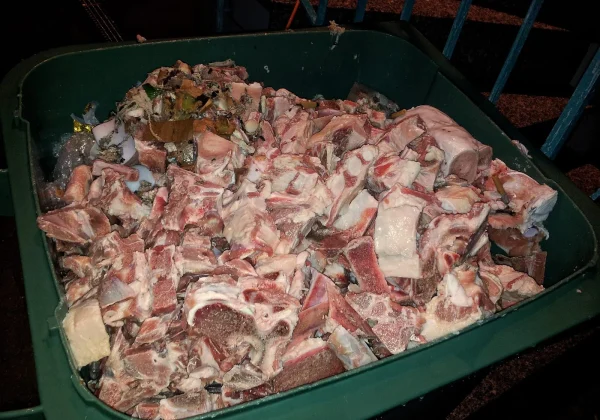

For pubs, restaurants, hotels, canteens and food manufacturers across the North West, commercial food waste collection has moved from a sustainability nicety to a legal obligation, and getting it right protects both your compliance position and your reputation. Martlands handles food waste collection as part of our wider fallen stock and ABP collection operation, diverting your waste away from landfill and into productive use while keeping the documentation that inspectors and assurance schemes expect. From our Burscough base we serve food businesses throughout Lancashire, Merseyside, Greater Manchester and beyond.
Why Food Waste Cannot Simply Go to Landfill Any More
Sending food waste to landfill is now both an environmental problem and, increasingly, a regulatory one. When organic matter breaks down in landfill it does so without oxygen, releasing methane, a greenhouse gas far more potent than carbon dioxide over the short term. Beyond the climate impact, the law in England has tightened around how businesses must separate and present their food waste, and premises that continue to mix it into general waste risk falling foul of the rules. A compliant collection arrangement removes that risk and turns a cost centre into a genuinely useful resource. For the regulatory detail behind the recent changes, our guide to the new business food waste separation law explains what the Simpler Recycling reforms mean for your premises.
Where Your Food Waste Actually Goes
The food waste we collect does not disappear into a hole in the ground; it is taken to permitted treatment, typically anaerobic digestion, where naturally occurring microorganisms break the material down in an oxygen-free environment. That process produces biogas, a renewable energy source that can be used to generate electricity, and a nutrient-rich digestate that can be returned to agricultural land as fertiliser. The result is a closed loop in which yesterday’s kitchen waste contributes to today’s energy and tomorrow’s crops, rather than sitting in landfill emitting methane for decades. For a food business, choosing this route is a measurable way to reduce the carbon footprint of the operation, and it provides a clear, defensible answer when a customer or auditor asks how your waste is handled.
Where Food Waste Becomes Animal By-Product
Not all food waste is treated identically, and the distinction matters for catering and manufacturing businesses in particular. Catering waste and former foodstuffs that contain or have been in contact with products of animal origin are classified as Category 3 animal by-product, and they must be handled under the Animal By-Products (Enforcement) (England) Regulations 2013 rather than as ordinary commercial waste. This is the point at which food waste collection and ABP collection overlap, and it is one of the reasons a licensed operator is the safer choice for a kitchen producing meat, fish or dairy waste. Our combined food waste and ABP collection service is built precisely for businesses that straddle both, and the specifics of catering material are set out in our Category 3 ABP collection service and our practical guide to disposing of catering waste.
Which Businesses Benefit Most
Any premises producing meaningful volumes of food waste stands to gain from a structured collection, but several sectors feel the benefit most directly. Pubs and clubs generate steady kitchen and plate waste through service. Restaurants and fast-food takeaways combine high turnover with large volumes of prepared food. Hotels produce diverse waste from dining rooms, function catering and room service. Canteens in schools, hospitals and workplaces feed large numbers daily and accumulate waste at scale. Food processing and manufacturing sites produce organic by-products that are far better recovered than discarded. In each case a reliable collection keeps the back of house clean, removes a recurring source of odour and pests, and provides the paperwork that demonstrates the waste has been dealt with responsibly. Leak-proof containers are supplied so that material is stored hygienically between visits rather than building up in open bins.
Reliable Collection Across the North West
Because Martlands already runs collection rounds throughout the North West, food businesses in our core areas benefit from a service that is genuinely local rather than routed in from a distant depot. We work with premises across Merseyside, Lancashire and Greater Manchester, and towns such as Liverpool, Southport, Preston and Ormskirk all sit comfortably within our regular operating area. Customers in the city can read more on our Liverpool food waste collection page, which sets out how the service works at a town level. Collections are scheduled around your trading pattern and managed through the KoLeCt system, so the timetable and the supporting documentation stay in step. Rather than quote a fixed price, we arrange collection frequency and container provision around your actual volumes, which is the fairest way to match the service to a kitchen’s real needs.
Arranging Your Collection
Putting compliant food waste collection in place is simple, and it consolidates a recurring operational headache into a single licensed arrangement backed by proper records. As a DEFRA approved facility and NFSCO member holding Waste Carrier Licence CB/QE5406MT and Site Licence EAWML/100236, Martlands gives hospitality, catering and food manufacturing businesses one dependable partner for both ordinary food waste and the Category 3 ABP element that so often sits alongside it. To set up a collection that fits your premises, or to talk through what the latest separation rules mean for you, call 01704 776977 or use our contact us page and we will tailor a service to your operation.